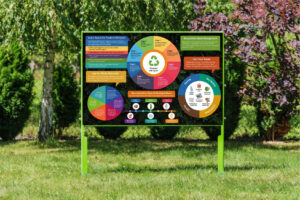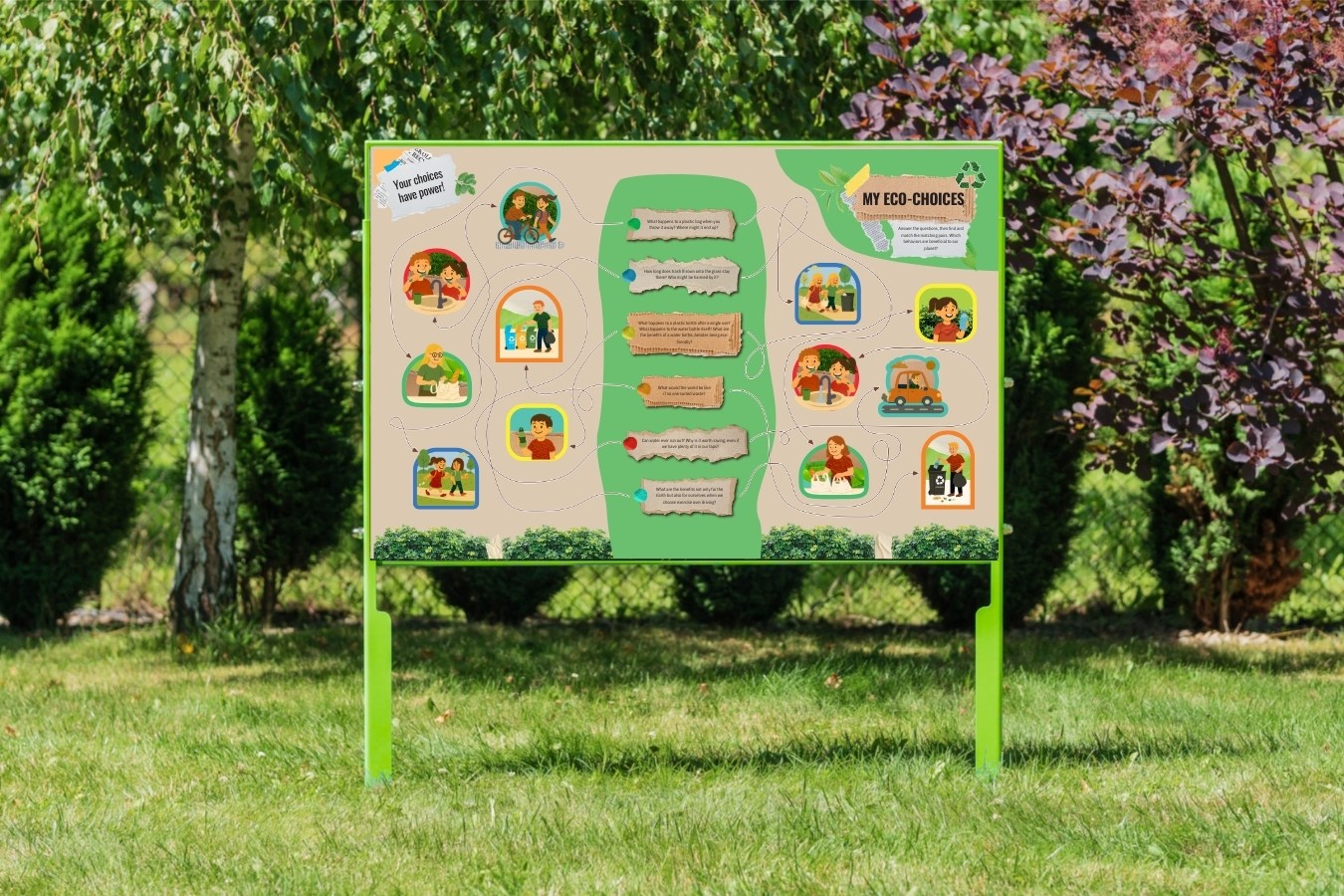
Do you want to introduce ecological education in a simple and engaging way in a school or kindergarten? The “Learning Waste Sorting” educational board is an interactive teaching tool that combines learning about ecology through play with practical pro-environmental activities. It is an ideal educational board for a school garden or as a permanent element of a playground.
WHAT IS THE “LEARNING WASTE SORTING” BOARD?
During the activity, children match illustrations of waste items to the appropriate bins – paper, glass, bio waste, plastic, metals, mixed waste, or special items. In this way they:
- Learn to recognize different types of waste.
- Develop awareness of why waste sorting is important.
- Build environmentally friendly habits from an early age.
Thanks to this simple and attractive form of education, children gain knowledge through movement, play, and cooperation with other children.
KEY BENEFITS OF THE “LEARNING WASTE SORTING” BOARD
✅ Learning through play – matching pictures to the correct bins makes learning enjoyable and easy to remember.
✅ Develops environmental awareness – children understand that proper waste sorting has a real impact on the environment.
✅ Strengthens logical thinking – the child analyzes what material an item is made of to assign it to the correct bin.
✅ Builds eco-friendly habits – teaches everyday good practices related to waste management.
WHY CHOOSE OUR EDUCATIONAL BOARD?
- Fun for multiple children at once – the board can accommodate up to 6 children (double-sided version).
- Compact size – perfect for a school garden or kindergarten outdoor area.
- All-weather resistant – resistant to rain, snow, and heat, suitable for year-round use.
- No teacher assistance required – children can use it independently or during environmental education classes.
- Edu-boxes – additional sets of magnets with ready-to-use activity scenarios that support curriculum implementation.
- Adjustable height – suitable for children aged 3–12 years.
WHERE DOES THIS EDUCATIONAL BOARD WORK BEST?
🏫 Schools and kindergartens – as a permanent element of an educational garden or playground.
🌳 Parks and educational gardens – an attractive learning experience for families with children.
🏛 Environmental education centers and museums – part of an educational path dedicated to recycling.
🚮 Waste management facilities – as part of exhibitions and educational campaigns.
FUN FACT
Every day, over 10 billion kilograms of waste are generated worldwide. Proper waste sorting is a real way to reduce this amount. Thanks to the “Learning Waste Sorting” board, children learn that small actions can have a big impact on the planet.